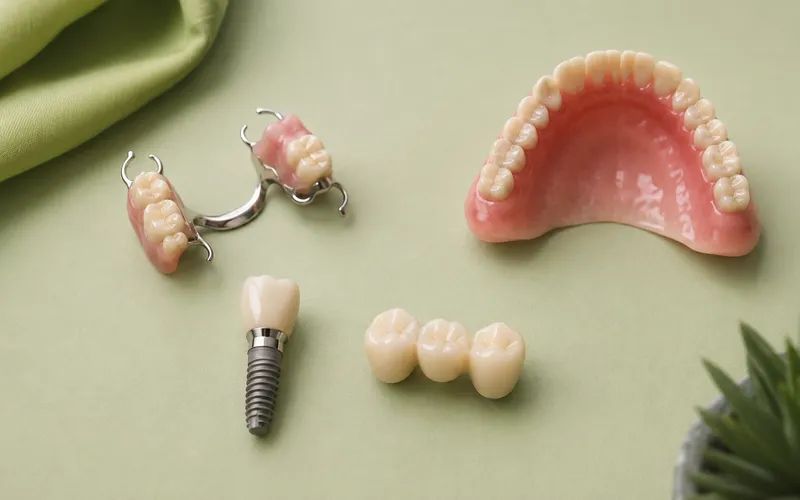
If you live in England and need missing teeth replaced, you are really choosing between three systems. The NHS offers dentures and bridges at a fixed charge. Private practices offer implants and more choice at private fees. And a growing number of people look abroad. Each has a different logic. This guide lays them side by side so you can see where your situation fits.
How NHS dental charges work for replacement teeth
NHS dental treatment in England is charged in bands. Each band covers a course of treatment, and you pay the charge for the highest band your treatment reaches. When we checked nhs.uk, the bands were listed as follows (NHS, page reviewed 2025):
| Band | Charge listed | Relevant to replacing teeth |
|---|---|---|
| Band 1 | £27.90 | Examination, X-rays, scale and polish, minor denture adjustments |
| Band 2 | £76.60 | Adds fillings, root canal treatment, extractions, extensive denture adjustments |
| Band 3 | £332.10 | Adds crowns, dentures (plastic or metal), bridges and other lab-made appliances |
| Urgent | £27.90 | Urgent care such as pain relief, up to two extractions, temporary fillings |
A few rules from the same page are particularly useful when teeth are being replaced:
- One charge per course. If your treatment includes extractions (Band 2) and a denture (Band 3), you pay the Band 3 charge once, not both.
- Denture repairs are free. If the denture cannot be repaired, you pay for a new one.
- Follow-up within two months. Further treatment within two months that falls in the same or a lower band costs nothing extra.
Charges change from time to time, and some people are entitled to free NHS dental treatment or help with costs. Confirm current figures and your eligibility with your practice or on nhs.uk.
What the NHS offers for missing teeth
Dentures
Band 3 explicitly includes dentures made from plastic or metal. That covers complete dentures for people with no teeth left and partial dentures that fill gaps between remaining teeth. For many people this is the most affordable route to a full set of teeth.
Bridges
Bridges also sit within Band 3. If a missing tooth has suitable neighbours, an NHS bridge can be an option. Whether a bridge is offered will depend on clinical need and your dentist's assessment of the supporting teeth.
Implants
Implants do not appear in the band descriptions on nhs.uk. Most people who want implants in England therefore plan to pay privately. If you have an unusual clinical situation, such as tooth loss from injury, illness or a developmental condition, ask your NHS dentist whether any referral route applies to you and what the criteria are, rather than assuming either way.
The three routes compared
| NHS (England) | Private UK | Abroad | |
|---|---|---|---|
| Dentures and bridges | Band 3 charge | Private fee; more choice of materials | Private fee; varies widely by country |
| Implants | Generally not routine | Widely available | Widely available |
| Regulator | GDC | GDC | Destination country's regulator, if one exists |
| Aftercare | Local practice | Local practice | Requires return trips or a UK dentist willing to take it on |
| Complaints route | NHS and GDC | Practice and GDC | Local systems abroad; GDC only if a UK-registered dentist was involved |
If you are thinking about going abroad
The General Dental Council has published guidance for people considering dental treatment outside the UK. Its main points, paraphrased (GDC, 2026):
- Research the country. Find out whether there is a dental regulator, whether registration is compulsory, and what qualifications and standards are expected. The GDC says not to assume there is an equivalent body or that standards match the UK's.
- Check the dentist. Confirm the people treating you are registered with the relevant regulator and properly qualified.
- Expect a full assessment by a qualified dentist before you receive a treatment plan and estimate, including your full medical history.
- Talk to your own dentist, both for advice based on your history and so they know your plans if complications arise.
- Ask plenty of questions, and do not feel you have to commit on the day. The GDC suggests asking about qualifications, language support, complication rates, guarantees, aftercare, who pays for remedial work and travel, and whether there is a complaints process.
Promotional events in the UK
The GDC also flags a specific risk: overseas providers sometimes hold consultation events in the UK. It warns that assessments or advice given at these events may count as dentistry, which only GDC-registered professionals can legally carry out in the UK. If the person assessing you is not registered, you lose the protection of the UK system. Check registration before you accept any assessment or advice.
Travel insurance and complications
Do not assume an ordinary travel policy covers planned treatment abroad or anything that goes wrong because of it. If you are travelling specifically for dental work, read the policy wording closely, ask the insurer directly in writing, and look into whether a policy designed for planned treatment exists. The GDC's suggested question about who pays for remedial work and travel is the practical version of this.
Timing: the hidden cost of each route
Money is only one part of the comparison. Time and continuity matter too.
- NHS: once you have a practice, a Band 3 course usually runs over several appointments for impressions, try-ins and fitting. The bigger timing issue for many people is finding an NHS practice taking new adult patients in their area.
- Private UK: implant plans usually involve healing periods between stages, but all appointments are local, and problems between stages can be seen quickly.
- Abroad: implant plans are compressed into one or more trips. Between trips, you rely on remote contact with the clinic, or on a UK dentist willing to help. Any unexpected issue can mean an extra flight.
When comparing quotes, add up the number of trips, the time off work, and what happens if a stage has to be repeated. A plan that looks cheaper on paper can lose that advantage if it needs an extra journey.
Practical questions for each route
If you are going NHS
- Is a denture or a bridge the better NHS option for my gap?
- Will this all be one Band 3 course?
- Am I eligible for free treatment or help with costs?
- If I might want implants later, does the NHS plan affect that?
If you are going private in the UK
- What does the quote include: scans, extractions, grafts, temporary teeth, the final crown or bridge?
- Which implant system will you use, and will I receive the component details?
- What is the maintenance schedule, and what does it cost?
If you are considering abroad
- Which regulator registers this dentist, and how do I check it myself?
- How many trips will this need, and what if something goes wrong between them?
- Will my UK dentist see me for maintenance, and will they need records?
- Who pays for remedial treatment and travel if a problem arises?
Mixing routes
Many people combine systems. A common pattern is to keep NHS care for check-ups, cleaning and simple treatment, and pay privately at home or abroad for implants. If you do this, tell your NHS dentist what you are planning before you go, and afterwards make sure they can see what was done, by whom, and with which parts. A dentist working blind on someone else's implants is at a real disadvantage. Our guide to aftercare with your home dentist covers the handoff in detail.
Be aware that if problems arise with private work, whether done in the UK or abroad, fixing them is usually private treatment too. Ask your NHS practice in advance how they handle patients with implants placed elsewhere.
Two examples
Jean, 70, Leeds. She has lost most of her lower back teeth and her old partial denture has cracked. An NHS course including a new metal-framed partial falls within a single Band 3 charge. Implants would make it steadier, but she is happy with a removable option, so the NHS route fits.
Sam, 49, Bristol. He lost a front tooth in an accident and is offered a conventional NHS bridge, which in his case would mean crowning both healthy neighbours. He prefers to leave those teeth alone and wants an implant. That means paying privately, either locally or abroad, and the choice comes down to price against the convenience of local follow-up.
How to decide
Start with what matters most to you. If cost is the main limit and a removable denture or a bridge would serve you well, Band 3 is hard to beat. If you want implants and value local follow-up, private UK treatment keeps everything under one regulator and close to home. If you want implants and the UK price is out of reach, going abroad can be reasonable, provided you do the verification the GDC describes and plan aftercare before you book.
For a neutral comparison of the replacement types themselves, read implant, bridge or denture. And whichever route you choose, take our list of questions to every consultation.
For UK patients, Colombia is a long-haul option compared with Europe, so it tends to make more sense for larger implant cases than for a single tooth. Whatever the destination, the GDC's advice applies: check the regulator, get a proper assessment, and involve your UK dentist. Compare provider options at colombiadentist.co, full-mouth cases at fullmouthrestoration.co, or start at the network hub, colombiamedical.co.
Frequently asked
Can I get dental implants on the NHS?
The NHS charges page we reviewed does not list implants in any band, so most people should plan on paying privately. If your situation is unusual, ask your NHS dentist directly whether a referral route exists for you and what it requires.
How much does an NHS denture or bridge cost?
Both fall under Band 3, which nhs.uk listed at £332.10 when we checked. That single charge covers the Band 3 course of treatment, including any Band 1 and Band 2 work in the same course. Charges are reviewed periodically, so confirm the current figure with your practice.
What happens if my NHS denture breaks?
According to nhs.uk, denture repairs are free, but if a denture cannot be repaired you pay for a new one. Contact your practice to arrange the repair.
Can a UK dentist fix implants that were placed abroad?
Many can carry out routine checks and maintenance, and some can deal with complications. It helps enormously to bring records listing the implant system and components. Treatment to fix work done abroad will normally be private, and you should ask about costs before it starts.
Does the GDC regulate dentists abroad?
The General Dental Council regulates dental professionals registered in the UK. Its guidance on treatment abroad advises patients to check whether the destination country has a regulator and whether the dentist is registered with it, because standards and protections may differ.
All prices are typical 2026 ranges drawn from published US self-pay data and Colombian clinic price lists, not quotes. USD/COP moved from roughly 3,805 to 3,070 during 2026, so dollar figures for Colombia have risen versus older articles. Only a clinic that has reviewed your scan can give you a real number. This is educational content, not medical advice.