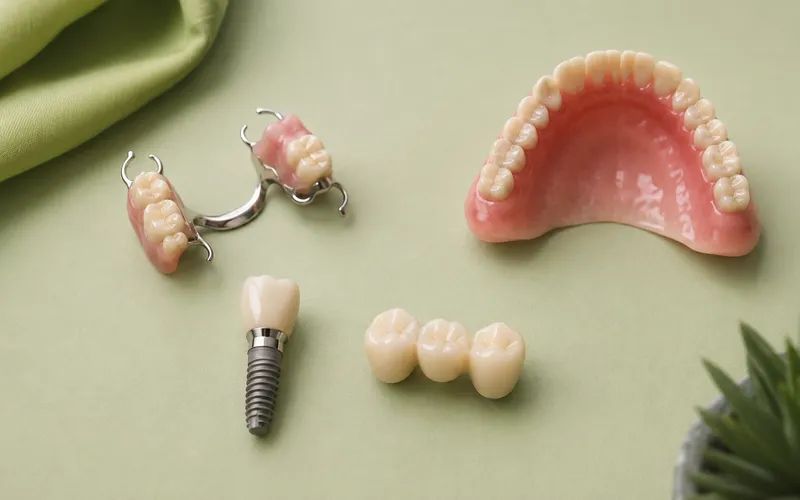
The Canadian Dental Care Plan (CDCP) has changed what many Canadians can afford when teeth need replacing. But the plan has its own logic: some prosthetic treatments are covered outright, some need approval in advance, cost sharing depends on income, and some treatments do not appear on the coverage list at all. This guide focuses only on what matters if you are missing teeth or about to lose them.
First, do you qualify?
The Government of Canada lists four conditions, and you must meet all of them (Government of Canada, updated September 2026):
- Income: adjusted family net income below $90,000.
- No access to private dental coverage: through work, pension, a family member's plan, a professional or student association, or a policy you buy yourself. There is a narrow exception for some retirees who opted out of pension dental coverage before December 11, 2023 and cannot opt back in.
- Tax filing: you and any spouse or common-law partner filed a Canadian tax return for the previous year.
- Residency: you are a Canadian resident for tax purposes.
The "access" wording matters. The test is framed around whether coverage is available to you, not only whether you signed up, so if you were offered workplace dental and turned it down, read the page carefully before applying. The page also explains a code on your T4 or T4A slip that shows whether you had access.
What the CDCP covers for replacing teeth
Replacement teeth fall under what dentists call prosthodontics. The CDCP coverage page splits this into removable and fixed services (Government of Canada, CDCP coverage, modified August 2026).
| Treatment | Listed on the coverage page? | Preauthorization |
|---|---|---|
| Complete dentures (standard) | Yes | Not required |
| Temporary complete dentures | Yes | Not required |
| Denture repairs, relines and rebases | Yes | Not required |
| Tissue-conditioning liners | Yes | Not required |
| Complete immediate dentures | Yes | Required |
| Overdentures | Yes | Required |
| Partial dentures | Yes | Required |
| Crowns, cores and posts | Yes | Required |
| Crown repairs and re-bonding | Yes | Not required |
| Bridges | Not mentioned | Ask your provider |
| Dental implants | Not mentioned | Ask your provider |
"Not mentioned" is not the same as "excluded". The coverage page refers readers to the CDCP Dental Benefits Guide and benefit grids for full detail. But it does mean you should verify before assuming that implants or bridges will be paid for.
How preauthorization works
The coverage page says some services, including those beyond established frequency limits, require preauthorization. Approval must be obtained before treatment begins, decisions take into account your oral health history and medical conditions, and not all requests are approved (Government of Canada, 2026).
In practical terms, if you are planning a partial denture, an immediate denture or an overdenture, build the approval step into your timeline. If teeth are being removed and you want to leave the extraction appointment with an immediate denture, ask your dental office to submit the request well before the extraction date.
A sensible order of steps
- Confirm with your dental office that they accept CDCP patients.
- Get an examination and a written treatment plan listing each procedure.
- Ask which items need preauthorization, and have the office submit the requests.
- Wait for decisions before starting treatment on those items.
- Ask for a written estimate of what you will owe after CDCP's share and any fee difference.
What you might still pay
For prosthodontic services, the coverage page sets out income-based cost sharing at CDCP's established fees (Government of Canada, 2026):
| Adjusted family net income | CDCP pays | You pay |
|---|---|---|
| Under $70,000 | 100% | 0% of the CDCP fee |
| $70,000 to $79,999 | 60% | 40% |
| $80,000 to $89,999 | 40% | 60% |
There is a second layer. Providers may charge more than the CDCP fee, and you would owe that difference on top of any co-payment. If you agree with your provider to services the plan does not cover, you pay for those directly. A clear written estimate before treatment avoids surprises.
Three households, three different bills
These examples are illustrative, using only the percentages above and no invented fees.
A retired couple with adjusted family net income of $52,000 needs a lower partial denture. They fall in the under-$70,000 band, so the CDCP pays its full established fee once the partial is preauthorized. Their out-of-pocket cost comes down to whether their denturist or dentist charges more than the CDCP fee.
A single parent at $76,000 needs a complete upper denture. The CDCP pays 60% of its fee and she pays 40%, plus any amount the provider charges above that fee. Asking two offices for written estimates could make a real difference.
A couple at $88,000 needs immediate dentures after extractions. The CDCP pays 40% of its fee once preauthorized; they pay 60% plus any fee difference. For them, the plan helps, but it is far from free, and the timeline for approval matters because the denture must be ready for extraction day.
Keeping a covered denture working
Because relines, rebases and repairs appear on the coverage list without preauthorization, a denture made under the CDCP can be maintained as your mouth changes. That matters most with immediate dentures, which loosen as the gums heal after extractions. Ask your provider at the start how relines will be handled and whether frequency limits might apply in your case, since services beyond those limits need approval.
Daily care helps the denture last too: rinse after meals, brush it with a soft brush and a non-abrasive cleanser, and keep it moist when it is out of your mouth. If it starts to rock, rub or click, book an adjustment rather than relying on extra adhesive.
Where implants fit for CDCP members
Because implants are not listed on the coverage page, many CDCP members will face a choice between a covered denture and paying for implant-based treatment themselves. That is not necessarily all-or-nothing. A few patterns are common:
- Start with a covered denture. A complete denture, with covered relines as the gums change, may meet your needs well.
- Ask about overdentures. Overdentures appear on the coverage list with preauthorization. Whether that extends to the implants underneath is a separate question your provider will need to check against the benefit grids.
- Pay privately for implants later. Some people use a covered denture now and add implants to stabilise it when they can afford to. Our guide to snap-in dentures explains how that works.
Thinking about the long-term cost of each route matters too. Our 20-year cost comparison looks at dentures and implants over time rather than at the first bill.
Treatment outside Canada
The CDCP pages we reviewed did not address treatment received abroad. If you are considering travelling for implants, plan as if you will pay that portion yourself unless the plan tells you otherwise in writing. You may still use the CDCP at home for parts of your care, such as examinations, extractions or a denture, depending on what it covers and your provider's advice.
One more practical point: a Canadian dentist who did not place your implants can only service them well if they know exactly what is there. Before you leave the foreign clinic, settle what paperwork you will take home, and read our guide to aftercare with your home dentist for the details worth requesting.
What to gather before your first appointment
- Your CDCP enrolment confirmation and member details.
- Your most recent notice of assessment, so you know which income band you fall in.
- A list of medications and medical conditions, since preauthorization decisions can take these into account.
- Any old X-rays or records from previous dentists, which can save repeat imaging.
- Notes on what bothers you most: pain, a loose denture, appearance, chewing. That helps the provider plan around your priorities.
Common mix-ups
- "The CDCP pays for everything." It pays at its own established fees, with income-based cost sharing, and some services need approval first.
- "If my employer offers dental but I declined it, I qualify." The eligibility page focuses on access, not enrolment.
- "Partials are covered, so I can start right away." Partial dentures need preauthorization before treatment.
- "Implants are banned under the CDCP." The coverage page simply does not list them. Verify with your provider and the benefit grids.
Questions to ask your dental office
- Do you accept CDCP patients, and do you charge above the CDCP fee for any of my planned treatment?
- Which items in my plan need preauthorization, and how long do decisions typically take?
- If my request is declined, what are my alternatives?
- Can you check the current benefit grids for implants, implant-retained overdentures and bridges for my situation?
- How many relines or adjustments to a new denture are covered?
The plan's details may be updated, and individual decisions depend on your records. Use this as a checklist, then confirm each point with your provider and the official CDCP pages.
For Canadians, Colombia is a direct comparison only for treatment the CDCP does not cover or covers partly, which, from the coverage page we reviewed, may include implants. Price your CDCP-covered options at home first, then compare like with like. Compare provider options at colombiadentist.co, full-mouth cases at fullmouthrestoration.co, or start at the network hub, colombiamedical.co.
Frequently asked
Does the Canadian Dental Care Plan cover dental implants?
The CDCP coverage page we reviewed lists dentures, relines and crowns but does not mention implants. Do not assume they are covered. Ask your dental office to check the current CDCP benefit grids for your province or territory, or submit a preauthorization request if your provider believes one applies.
Do I need preauthorization for dentures under the CDCP?
According to the coverage page, standard and temporary complete dentures are covered, while complete immediate dentures, overdentures and partial dentures need preauthorization. Approval must be in place before treatment starts, and not every request is approved.
Will I pay anything for dentures under the CDCP?
Possibly. For prosthodontic services, the plan pays 100% of its set fees if adjusted family net income is under $70,000, 60% between $70,000 and $79,999, and 40% between $80,000 and $89,999. Your provider may also charge more than the CDCP fee, and you would pay the difference.
Who qualifies for the CDCP?
The eligibility page lists four conditions: adjusted family net income under $90,000, no access to private dental insurance, tax returns filed in Canada for the previous year by you and any spouse or partner, and Canadian residency for tax purposes. Check the page for the limited exception for retirees who opted out of pension dental coverage.
Can I use the CDCP for dental work outside Canada?
The pages we reviewed did not address treatment abroad. Assume CDCP benefits apply through participating providers in Canada unless the plan confirms otherwise in writing.
All prices are typical 2026 ranges drawn from published US self-pay data and Colombian clinic price lists, not quotes. USD/COP moved from roughly 3,805 to 3,070 during 2026, so dollar figures for Colombia have risen versus older articles. Only a clinic that has reviewed your scan can give you a real number. This is educational content, not medical advice.