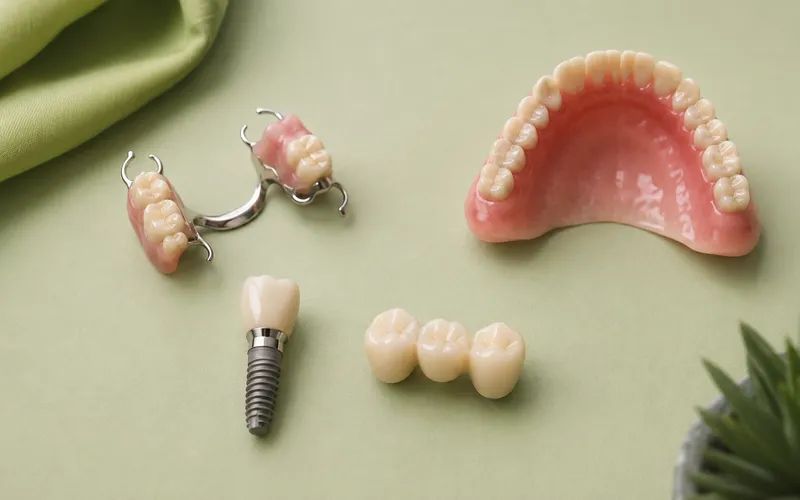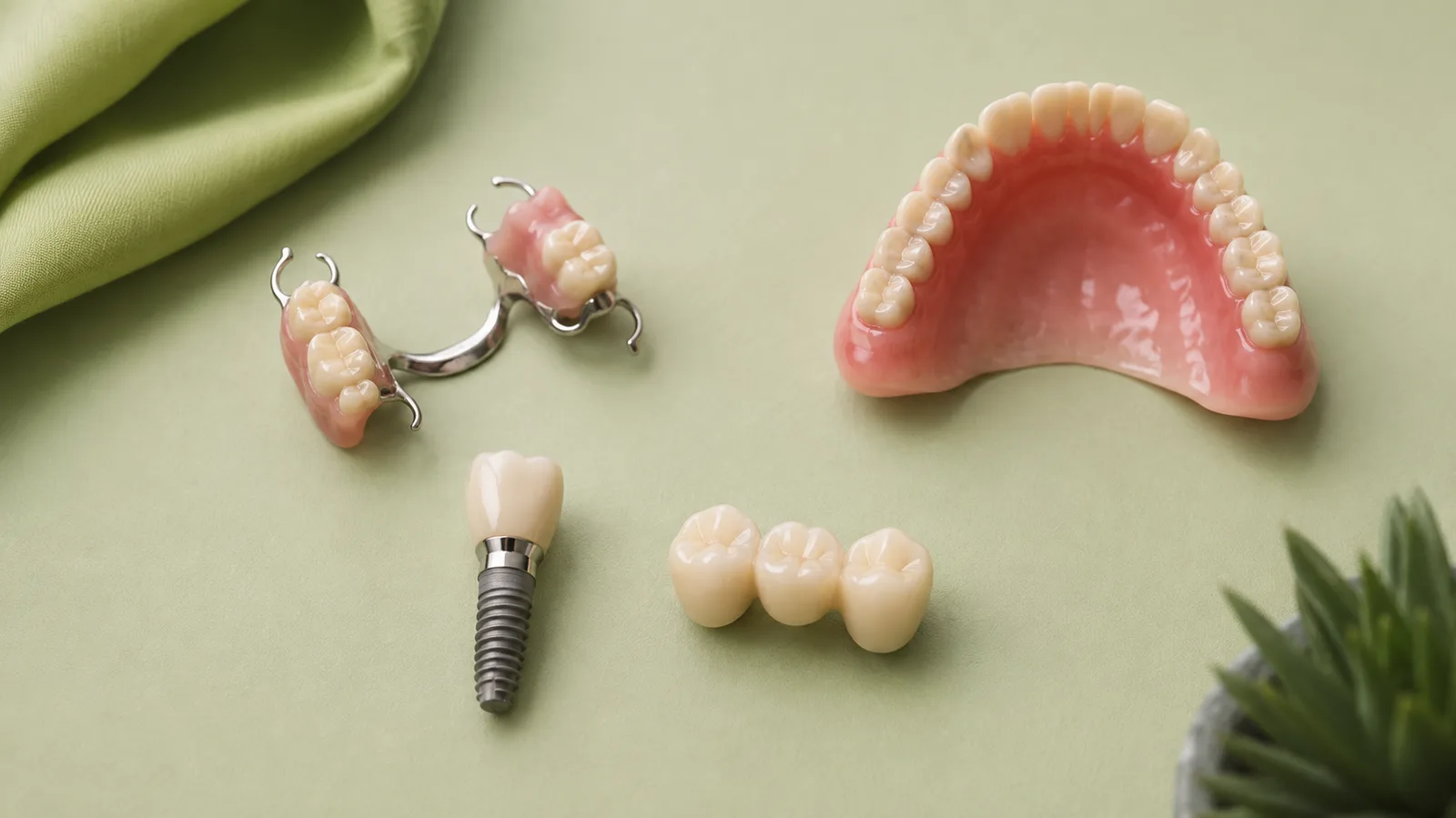
If you are missing several teeth but still have healthy ones left, a removable partial denture is often the most affordable way to fill the gaps. Then comes a second choice that rarely gets explained well: should it be a flexible partial with no visible metal, a partial built on a cast metal frame, or a simpler all-acrylic one? Each has strengths, and the marketing around flexible partials sometimes overstates them. Here is a balanced look.
The three main kinds of removable partial
Cast metal framework partial
A thin, rigid metal frame (usually a cobalt-chromium alloy) carries the false teeth on pink acrylic. Metal clasps grip the natural teeth, and small rests sit in shallow seats prepared on those teeth so the partial is supported by the teeth as well as the gum. This is the traditional long-term removable option.
Flexible (thermoplastic) partial
Made from a flexible resin, often a nylon-type thermoplastic. Instead of metal clasps, the gum-coloured base itself wraps around the necks of the teeth, which is why it is often marketed as invisible. It flexes into place rather than clicking.
Acrylic partial
A rigid pink acrylic base, often with simple wire clasps. It is usually the quickest and least expensive to make, easy to add teeth to, and is frequently used as a temporary or transitional denture.
What the evidence actually says about flexible dentures
In 2025, Canada's Drug Agency (formerly CADTH) published a rapid review comparing flexible dentures with conventional removable dentures. It found seven randomised trials and one non-randomised study. The headline findings were that flexible dentures may improve overall satisfaction and aesthetics, but may be inferior for retention, meaning how well they stay in place. Speech, pain when eating, and fractures or discolouration looked comparable, while chewing ability, oral health-related quality of life and maintenance effort varied between studies (Canada's Drug Agency, Canadian Journal of Health Technologies, 2025).
The same review flagged important limitations. Many outcomes were measured subjectively, patients and assessors were not blinded, and no study followed patients long enough to judge durability over the lifespan of a denture. It found no cost-effectiveness studies, though it noted flexible dentures may cost more than conventional ones. In other words, flexible partials are not proven inferior or superior overall. They trade some grip for appearance and comfort, and their long-term record is still thin.
Side-by-side comparison
| Cast metal frame | Flexible thermoplastic | Acrylic | |
|---|---|---|---|
| Visible metal | Possible, depending on clasp position | None | Wire clasps may show |
| Bulk in the mouth | Thinnest, because metal is strong in thin sections | Moderate | Usually the bulkiest |
| Support | Rests on teeth share the load | Mostly gum-supported | Mostly gum-supported |
| Retention | Generally firm | May be weaker (CDA review, 2025) | Variable |
| Adding a tooth later | Often possible | Often difficult or not possible | Usually easy |
| Relining | Possible on the acrylic parts | Often difficult | Straightforward |
| Metal allergy | A concern for a small number of people | Metal-free | Can be metal-free |
| Typical role | Long-term removable solution | Aesthetic choice; sometimes transitional | Temporary or budget option |
When a flexible partial tends to make sense
- A visible gap near the front where a metal clasp would show on a canine or premolar.
- A confirmed allergy to the metals used in frameworks.
- Small undercuts and bulky gums where a rigid partial would be hard to insert comfortably.
- A temporary role, for example while implant sites heal, where appearance matters for a few months.
When a metal frame is usually the better bet
- Several missing back teeth where chewing forces are high and support from the teeth helps.
- A mouth that is still changing, where you may lose more teeth and want to add them to the existing partial.
- Long free-end gaps at the back with no tooth behind them, where stability is a challenge.
- People who want the least bulk covering the palate or tongue side.
How a partial is made and fitted
The process differs slightly by material, but most partials take several appointments rather than one. A typical sequence:
- Examination and planning. The dentist checks the remaining teeth, treats any decay or gum problems first, and decides which teeth will carry the partial. Teeth with poor support make poor anchors.
- Tooth preparation, for metal frames. Small seats may be shaped on some teeth so the metal rests sit flush. Flexible and acrylic designs usually skip this.
- Impressions or scans. These go to the lab, sometimes with a bite record.
- Framework try-in, for metal frames. The bare metal frame is checked for fit before teeth are added.
- Tooth try-in. False teeth set in wax are checked for appearance and bite.
- Fitting and adjustments. The finished partial is fitted, and sore spots are eased at follow-up visits.
The first weeks
Expect the partial to feel large at first, and to notice it when you speak and swallow. Most people find that sensation fades, but persistent rubbing or ulcers mean the fit needs attention. Practise putting it in and taking it out in front of a mirror. Do not bite it into place, which can bend clasps or crack the base; guide it in with your fingers.
The hidden questions: repairs, relines and the future
When people compare partials, they usually compare looks and price. The question that matters more after a year or two is what happens when something changes.
Gums and bone under a partial continue to remodel over time, so the fitting surface eventually needs relining. Teeth that support a partial can be lost, and you may want a false tooth added. Clasps can loosen or break. With acrylic and metal-framed designs, labs can generally add teeth, reline and repair. With many flexible materials, those jobs are harder, and some labs will only remake the whole partial. Before you choose, ask the dentist plainly: if I lose the tooth this clasp holds, what are my options with this design?
Cleaning and caring for a partial
Whatever the material, plaque collects where the partial touches the natural teeth, and that can lead to decay and gum problems around the very teeth it relies on. A daily routine usually looks like this:
- Take the partial out and rinse it to remove loose food.
- Brush the partial with a soft brush and a non-abrasive cleanser; regular toothpaste can scratch some materials.
- Brush and floss your natural teeth thoroughly, paying attention to the teeth the partial clips onto.
- Store it as your dentist advises, often in water or a cleaning solution, so it does not dry out or warp.
- Avoid very hot water, which can distort some denture materials.
Ask your dentist which cleaning products suit your partial, because some soaking solutions are not recommended for certain flexible materials or metal frames.
A partial as a step towards implants
Many people choose a partial now and plan implants later. If that is you, a few points are worth raising at the start:
- A metal-framed partial can sometimes be modified to work with one or two implants placed later to improve support at the back.
- A flexible partial might suit a temporary role during healing, but check that it will not press on new implant sites.
- Bone keeps changing under any partial, so if implants are your real goal, do not let years slip by without a scan.
For bigger-picture planning, read replacing several missing teeth, and if you are closer to losing all your teeth, snap-in dentures show where implants come in.
Questions to ask your dentist
- Which design do you recommend for my mouth, and what would you choose if appearance did not matter?
- Will any clasp show when I smile? Can it be hidden?
- Will this partial be supported by my teeth, my gums or both?
- If I lose another tooth, can a tooth be added to this partial?
- Can it be relined, and how often do you expect that?
- How many adjustment visits are included after fitting?
A quick way to decide
If appearance is the main driver and the gap is near the front, a flexible partial deserves consideration, with a clear understanding that it may grip less firmly and be harder to modify later. If function, durability and adaptability matter most, especially for back teeth, a metal-framed partial is the conventional long-term choice. If you need something soon, cheaply or temporarily, acrylic is the practical stopgap. None of the three is a permanent answer to bone loss, which is where implant-based options come into the conversation (see implant, bridge or denture).
A partial denture usually takes several appointments for impressions, try-ins and adjustments, so it fits best into a longer stay or as part of a larger plan. Ask how adjustments and repairs will be handled once you are home. Compare provider options at colombiadentist.co, full-mouth cases at fullmouthrestoration.co, or start at the network hub, colombiamedical.co.
Frequently asked
Are flexible partial dentures better than metal ones?
Not across the board. A 2025 rapid review by Canada's Drug Agency found flexible dentures may improve appearance and overall satisfaction but may be worse at staying in place, with many other outcomes mixed. Which is better for you depends on your remaining teeth, your bite and how much you value appearance against grip and repairability.
Can a flexible partial be relined or have a tooth added?
It is often harder than with acrylic or metal-framed partials, and some labs cannot do it at all with certain thermoplastic materials. If you expect to lose more teeth, ask the dentist directly whether this specific partial can be extended later.
Will people see the clasps on a metal partial?
It depends on which teeth the clasps hold. Clasps on back teeth are often hard to see, while a clasp on a canine or premolar can show when you smile. Dentists can sometimes adjust the design to hide them, or use tooth-coloured or gum-coloured clasp alternatives.
Why is my partial denture rubbing my gums?
New partials commonly need small adjustments in the first weeks. Persistent rubbing, ulcers or pain should be checked by your dentist rather than ignored, because the fit may need correcting.
Do partial dentures damage the teeth they clip onto?
They can contribute to problems if plaque builds up around the clasps or if the partial rocks and overloads the support teeth. Good daily cleaning of both the partial and the teeth, regular checkups and a well-fitting design reduce that risk.
All prices are typical 2026 ranges drawn from published US self-pay data and Colombian clinic price lists, not quotes. USD/COP moved from roughly 3,805 to 3,070 during 2026, so dollar figures for Colombia have risen versus older articles. Only a clinic that has reviewed your scan can give you a real number. This is educational content, not medical advice.