You have had a back molar taken out, or you are about to, and the dentist offers you an implant, a bridge or a partial denture. Then a thought arrives: do I actually need anything there? I can still chew on the other side. Nobody sees it. That question is more reasonable than it sometimes sounds in a dental chair, and the answer is not always yes.
The idea dentists call the "shortened dental arch"
There is a recognised concept in dentistry called the shortened dental arch. Instead of aiming to replace every lost back tooth, it accepts a mouth that keeps the front teeth and premolars working together, even if some or all of the molars are missing. It is often described as about ten pairs of opposing front and premolar teeth, and it lines up with the long-standing public-health goal of keeping around 20 functional natural teeth for life.
A 2014 systematic review in PLoS One compared adults with shortened arches who had and had not been given removable dentures to fill the gaps. It found the shortened arch approach encouraging in terms of patient satisfaction, functioning and cost-effectiveness. It also cautioned that the evidence was limited: five studies, only some outcomes of moderate quality, and too much variation between studies to combine the data, with a call for more long-term research (Khan et al., PLoS One, 2014, summarised by the Dental Elf).
The practical takeaway is not "molars do not matter". It is that a mouth without some molars can still work well for many people, so replacing them is a choice to weigh, not an automatic step.
Which molar is missing makes a big difference
| Tooth | Role | How often replacement is recommended |
|---|---|---|
| Wisdom tooth (third molar) | Often does little chewing; frequently removed | Almost never replaced |
| Second molar | Helpful but often not essential if the rest of the arch is healthy | Often left as a gap, especially if it is the last tooth |
| First molar | A major chewing tooth with a large role in the bite | More commonly recommended, particularly when it sits between other teeth |
| Several molars on the same side | Chewing shifts heavily to the other side | Usually worth a serious conversation |
This is a general pattern rather than a rule. Your own bite, the condition of the other teeth and what you eat all matter.
What can happen if you leave a gap
Neighbouring teeth may tip
Teeth are held in place partly by contact with their neighbours. Remove one, and the tooth behind it can tilt forward into the space over time. A tilted tooth is harder to clean, can trap food, and can make a later implant or bridge harder to place.
The opposing tooth may drift
The tooth directly above or below the gap no longer has anything to bite against. It can slowly move out of its socket towards the space, a process dentists call over-eruption. If that goes far enough, it can interfere with your bite or make it difficult to fit a replacement later without adjusting or treating the opposing tooth.
The bone in the gap shrinks
Without a root, the ridge of bone tends to narrow and flatten over time. If you never plan an implant, this matters less. If you might want one later, it can mean a graft. Our guide to bone loss after missing teeth covers what that means for your options.
Chewing shifts to the other side
Many people adapt without noticing. Others find that one side becomes overloaded, especially if teeth there have large fillings or crowns. If chewing on the remaining side is uncomfortable, that is worth telling your dentist.
None of these happens on a fixed timetable, and some people see very little change for years. That variability is exactly why monitoring is useful.
When leaving the gap is a reasonable choice
- The missing tooth is a second or third molar at the very back of the mouth.
- The remaining front teeth and premolars are healthy and meet well.
- You chew comfortably and are not avoiding foods.
- The opposing tooth is also missing, or is stable and unlikely to drift.
- Surgery or a large dental expense would be a real burden right now, medically or financially.
- You are willing to attend regular checkups so changes can be caught early.
When replacing it is usually worth considering
- It is a first molar with healthy teeth on both sides of the gap.
- You notice food trapping, tipping of the neighbouring tooth, or a change in your bite.
- You have already lost several back teeth and the remaining ones are carrying all the load.
- The teeth on the other side are heavily restored and you are relying on them alone.
- You want to keep the option of an implant without needing a bone graft later.
If you do replace it: options for a single back tooth
| Option | Suits | Trade-off |
|---|---|---|
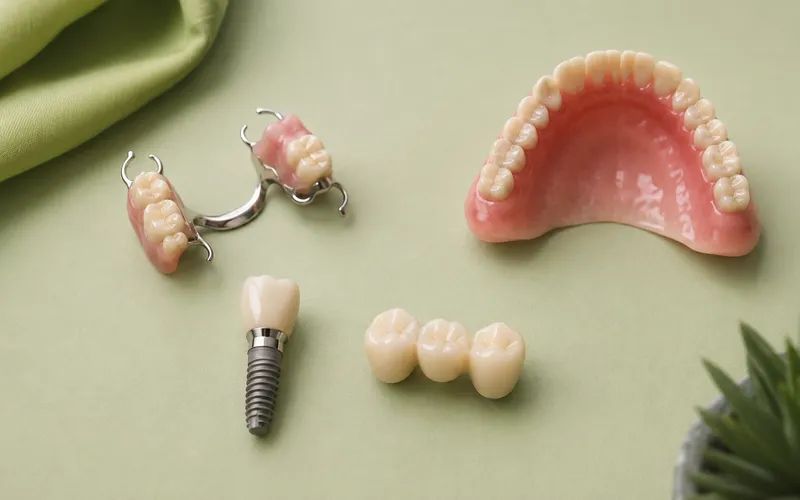
| Single implant + crown | A gap with healthy neighbours and enough bone | Surgery and healing time; highest upfront cost |
| Conventional bridge | Neighbours that already need crowns | Both neighbours are cut down for crowns |
| Removable partial | Several gaps, a tight budget, or a temporary need | Removable; covers more of the mouth; less stable |
| Nothing, with monitoring | Back-of-mouth gaps in a healthy, stable arch | Possible drifting and bone change over time |
For what a single implant involves from start to finish, see a single tooth implant. For gaps in more than one place, replacing several missing teeth walks through the combinations.
A middle path: decide, then review
If you are unsure, you do not have to choose today between an implant and doing nothing forever. A practical approach many patients find reassuring:
- Ask the dentist to record the current state: photos, an X-ray, or a scan of the area.
- If the tooth has just been removed, ask whether socket preservation makes sense to keep the implant option open.
- Agree a review interval, for example at your next routine checkup.
- At the review, compare the records. Has the neighbour tipped? Has the opposing tooth moved? Is chewing still comfortable?
- Decide again with that information.
This approach treats the gap as something to watch rather than an emergency, while keeping you from drifting into a situation where options have narrowed without you noticing.
Three people, three sensible answers
Ana, 58, lost a lower second molar. It was the last tooth on that side, the tooth above it is also missing, and the rest of her mouth is healthy. She chews well. Leaving the gap and checking it at routine visits is a sound, low-cost decision.
David, 44, lost a lower first molar. There are healthy teeth in front of and behind the gap, and an upper molar above with nothing to bite against. He is young enough that drifting and bone change have decades to play out. Replacing the tooth, most likely with an implant if the bone allows, deserves serious thought.
Marta, 67, has lost three back teeth over ten years, scattered across both sides, and has started cutting food into tiny pieces. Her question is no longer about one molar. It is about how her mouth will function over the next twenty years, and a plan covering all the gaps together will likely serve her better than tooth-by-tooth decisions.
None of them is wrong to ask whether a replacement is necessary. The answer simply depends on where the gap is, what surrounds it and how many years it will have to be lived with.
How to tell whether advice is balanced
A balanced recommendation usually explains why this particular gap matters in your particular mouth: which tooth is likely to move, what the bite looks like, how the bone is now. Be cautious with blanket claims that every missing tooth must be replaced immediately, and equally cautious with advice that dismisses all gaps as harmless. The truth sits in the details of your bite.
Questions to ask your dentist
- If I leave this gap, what specifically do you expect to happen, and over what kind of period?
- Is the opposing tooth likely to drift? Is there anything we can do to prevent it?
- Does my bite rely on this tooth more than average?
- If I want an implant in a few years, how much harder will it be?
- Can we record the area now and review it at my next visit?
Leaving a back gap is not a failure to look after your teeth. It can be a considered decision, as long as it is made with your eyes open and checked over time.
If you decide a back gap is worth filling, the cost difference abroad can make an implant realistic where it was not at home. If you decide it is not worth filling, that is a legitimate choice too, and nobody should talk you out of it with a travel package. Compare provider options at colombiadentist.co, full-mouth cases at fullmouthrestoration.co, or start at the network hub, colombiamedical.co.
Frequently asked
Is it bad to leave a missing molar unreplaced?
Not automatically. Many people manage well without their last molars, and a recognised approach called the shortened dental arch accepts a mouth without molars when the front teeth and premolars are healthy. It becomes a problem when neighbouring or opposing teeth start drifting, chewing becomes difficult, or the gap is part of a wider pattern of tooth loss.
Will the teeth next to the gap really move?
They can. Teeth tend to tip into an empty space, and an opposing tooth with nothing to bite against can drift out of its socket over time. How much and how fast varies a great deal between people. Regular checkups with comparison X-rays or photos are the easiest way to track it.
Does a missing molar cause bone loss?
The bone that held the tooth tends to shrink after the tooth is gone, because it no longer carries a root. That matters mainly if you might want an implant later, because a thinner ridge can mean grafting. Our article on bone loss after missing teeth explains this in more depth.
Is a missing wisdom tooth or second molar the same as missing a first molar?
No. Wisdom teeth are commonly removed and almost never replaced. The second molar is often left unreplaced when the rest of the arch is healthy. The first molar does more chewing work and its loss affects the bite more, so dentists more often recommend replacing it.
Can I wait and replace the tooth later?
Often, yes, but waiting has trade-offs. Bone can thin and teeth can shift, which can make an implant more complex later. If you are unsure, ask your dentist to record the current position with photos or a scan so you can make a better-informed decision in a year or two.
All prices are typical 2026 ranges drawn from published US self-pay data and Colombian clinic price lists, not quotes. USD/COP moved from roughly 3,805 to 3,070 during 2026, so dollar figures for Colombia have risen versus older articles. Only a clinic that has reviewed your scan can give you a real number. This is educational content, not medical advice.